Signature: Cage on Rauschenberg
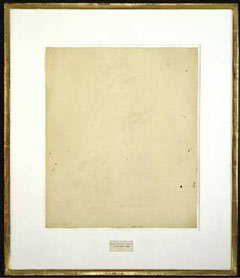
 Cage assumes, "Let to myself, I would be perfectly contented with black pictures, providing Rauschenberg had painted them" (Silence, 107). One is led to ask, then, what is the role of the artist, whose hand is simultaneously visible and invisible? The answer lies not in Rauschenberg's artistic talent or capabilities as a painter, but rather his unique status as a thinker and dreamer. In other words, the all black paintings are interesting on a conceptual level. Perhaps Cage would not be able to distinguish Rauschenberg's black paintings from those done by an imitator, but Rauschenberg's ideas were uniquely his own: paint on newspaper, and he did. This holds true for the erased De Kooning and the tire track as well. The discussion of the work changes from "how these marks work together as a whole" or (per Greenberg's ideals) "how these marks demonstrate what is fundamental to painting" to "what was done to produce this work." This shift had already begun to take place during abstract expressionism (particularly in Rosenberg's reading of the movement) and before. However, Rauschenberg's work compelled critics and observers to focus less and less on the actual overall product and more and more on the circumstances and material of its production, their multifaceted character, and the comparably passive role that Rauschenberg played in his own works. In reference to Automobile Tire Print (1953), John Cage ask, "But which of us drove the car?" (98). Cage's point is that it doesn't matter. What matters is that someone thought to make the tire print and followed through so that the object is now in the world. Rauschenberg's hand might be somewhat absent from his pieces, but his signature is always there in one form or another, as is Cage's.
Labels: Cage, materiality of the signifier, Rauschenberg, signature
posted by KP @ 9:43 AM


0 Comments:
Post a Comment
Subscribe to Post Comments [Atom]
<< Home